Critical Thinking

Critical thinking is more than just thinking carefully; it is about thinking clearly, logically, and ethically. Over the course of my learning, I have developed a deeper understanding of moral reasoning, ethical theories such as utilitarianism, rule utilitarianism, and self-interest theory, as well as how to approach ethical dilemmas with a structured and reflective mindset. This journey has not only improved my academic skills but has also influenced how I make decisions in everyday life.

One of the most important concepts I learned is moral reasoning. Moral reasoning is the process of determining what is right or wrong in a given situation. It requires us to go beyond personal opinions and emotions and instead rely on principles, evidence, and logical thinking. Before studying this topic, I often made judgments based on instinct or personal values without fully analyzing the situation. Now, I understand that moral reasoning involves asking questions such as: Who will be affected? What are the possible consequences? Are there any ethical principles involved? By systematically examining these questions, I can arrive at more balanced and justified conclusions.

A key theory that shaped my understanding of moral reasoning is utilitarianism. Associated with philosophers like Jeremy Bentham and John Stuart Mill, utilitarianism argues that the morally right action is the one that produces the greatest good for the greatest number of people. This outcome-based approach emphasizes consequences rather than intentions. I found this theory both practical and challenging. On one hand, it encourages us to think about the broader impact of our actions. On the other hand, it raises difficult questions: What if achieving the greatest good harms a minority? Is it always fair to prioritize the majority? Reflecting on utilitarianism helped me realize that ethical decisions are rarely simple and often involve trade-offs.

Building on this idea, I also learned about rule utilitarianism. Unlike act utilitarianism, which evaluates each action individually, rule utilitarianism suggests that we should follow rules that generally lead to the greatest good. For example, a rule such as “do not lie” tends to create trust and stability in society, even if lying in a specific situation might produce a better short-term outcome. This perspective helped me understand the importance of consistency and long-term consequences in ethical thinking. It showed me that moral systems need structure, not just case-by-case calculations.

Another important theory I explored is self-interest theory, which argues that individuals should act in ways that promote their own long-term interests. At first, this seemed selfish or morally questionable. However, through critical reflection, I realized that self-interest theory does not necessarily mean harming others. Instead, it can involve making rational decisions that protect one’s well-being and future. For instance, choosing to study instead of procrastinating may not provide immediate pleasure, but it serves my long-term goals. This theory made me reflect on the balance between personal benefit and social responsibility.

Ethical dilemmas were one of the most engaging parts of my learning. An ethical dilemma occurs when there are two or more conflicting moral principles, and choosing one means compromising another. These scenarios forced me to apply the theories I learned rather than just memorize them. For example, in a situation where telling the truth could cause harm, utilitarianism, rule utilitarianism, and self-interest theory might each suggest different actions. Working through such dilemmas taught me that critical thinking requires patience, open-mindedness, and the ability to tolerate uncertainty.

Learning how to think critically has been transformative. Critical thinking involves analyzing arguments, identifying assumptions, evaluating evidence, and considering alternative perspectives. I learned to question sources of information, distinguish between facts and opinions, and recognize biases — including my own.

Overall, studying moral reasoning and ethical theories has expanded my understanding of right and wrong. Utilitarianism and rule utilitarianism taught me to consider consequences and societal rules, while self-interest theory highlighted the importance of long-term personal well-being. Ethical dilemmas challenged me to apply these theories in complex situations. Most importantly, learning how to think critically has given me the tools to approach problems thoughtfully and responsibly. This experience has not only shaped my academic growth but has also prepared me to make more informed and ethical decisions in the future.

Attending the critical thinking classes has been an enriching and thought-provoking experience. One of the central themes discussed was the concept of knowledge and the process of knowledge acquisition. We explored what knowledge truly means and how it is not limited to facts and information, but also includes understanding, interpretation, and reasoning. It was interesting to realize that knowledge can be acquired through various sources such as personal experience, observation, education, discussion, and reflection. We also examined how our beliefs, biases, and prior experiences influence what we accept as knowledge. This made me reflect on the importance of questioning information rather than accepting it at face value.

A particularly engaging part of the session was the discussion on the case of Jammu and Kashmir (J & K). Instead of viewing it from a single narrative, we were encouraged to examine it from multiple perspectives, including political, historical, social, and humanitarian viewpoints. This exercise highlighted how the same situation can be interpreted differently depending on one’s background, values, and access to information. It reinforced the idea that critical thinking requires openness, empathy, and the willingness to consider diverse viewpoints.

The discussion helped me understand that knowledge is not always absolute or fixed; it can evolve with new evidence and perspectives. It also emphasized the importance of being an active learner—asking questions, analyzing information carefully, and being aware of biases. Overall, the class strengthened my ability to think more deeply and objectively about complex issues. It reminded me that true learning goes beyond memorizing facts; it involves understanding context, evaluating perspectives, and developing informed opinions. This experience has encouraged me to become a more reflective and responsible learner.
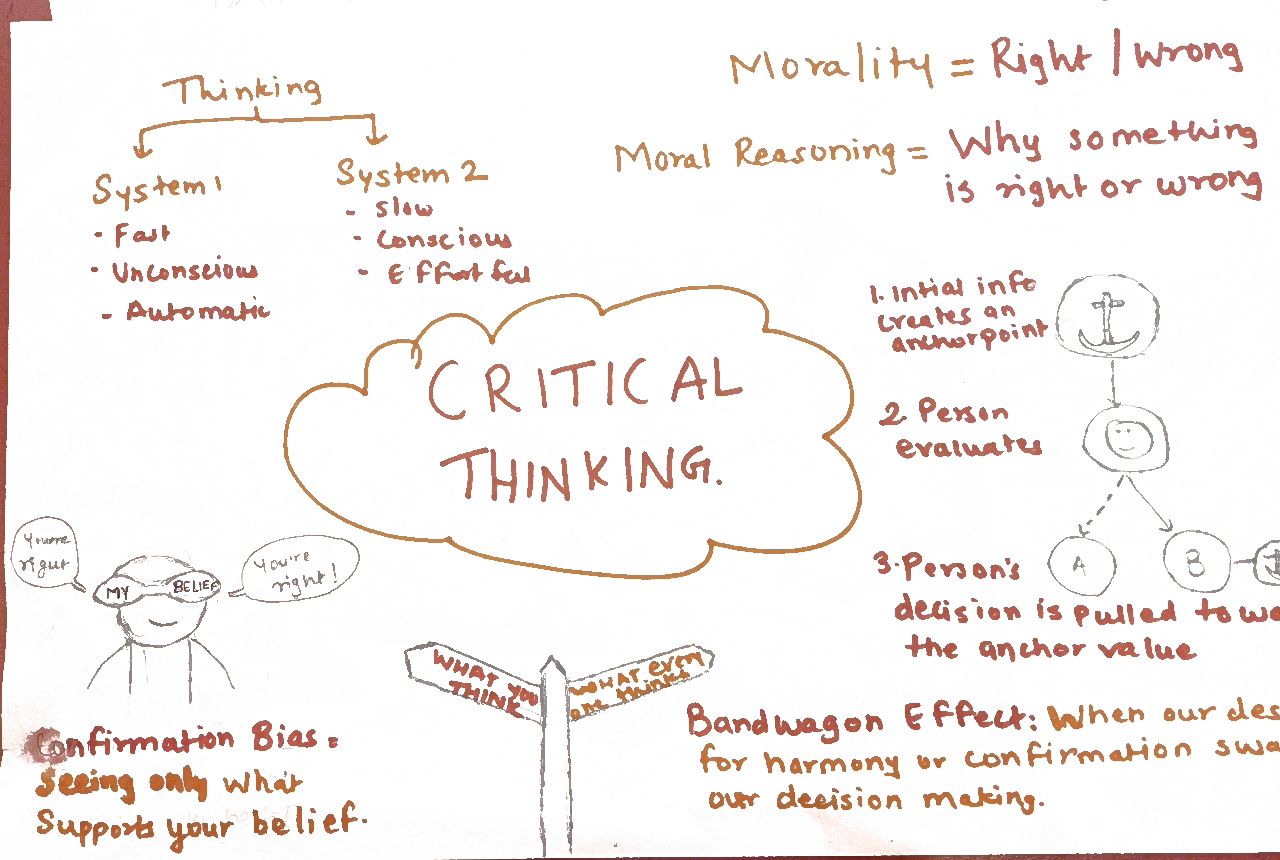
Critically Analysing my Thoughts

This Life class has been a meaningful and enriching experience. It encouraged us to slow down, think more deeply, and avoid jumping to conclusions. Through thoughtful discussions and real-world examples, we learned how to question our assumptions and consider multiple viewpoints before forming opinions.
As the sessions progressed, everyone became more comfortable sharing their thoughts, and the conversations grew more open and respectful. Overall, the workshop has helped us become more mindful thinkers and better listeners, which will definitely support us in both academic and real-life situations.

Last year, when I began the Critical Thinking class, I thought it would simply be about debating or questioning others. Gradually, I learned that it is about questioning myself, my assumptions, and the information I receive. I learned to differentiate facts from opinions, identify biases, and evaluate evidence before forming conclusions. This learning impacted my daily life deeply. For example, while planning to buy a house, I did not rely only on emotions; I calculated total costs, compared interest rates, and assessed long-term risks before deciding. Even in classroom discussions, I now encourage multiple perspectives instead of one fixed view. Critical thinking has made me more reflective, rational, and confident in my decisions.

Learnings of CT day 7

Ethical theories like Utilitarianism, associated with John Stuart Mill, Deontology by Immanuel Kant, and Moral Relativism help us understand how to make moral decisions in real life. Utilitarianism focuses on the greatest good for the greatest number, but it may ignore individual rights. Deontology emphasizes duty and moral rules, yet it can be rigid in difficult situations. Moral relativism highlights cultural differences but may weaken universal values. These theories show that ethical dilemmas are complex and require balancing consequences, principles, and context. Overall, they teach us responsibility, integrity, and open-minded thinking in decision-making.

A few important lessons stand out

1. Gaps between social practice and legal protectionSome traditions or practices can become harmful when misused. These cases show how vulnerable people — especially women — may need stronger awareness of their legal rights and access to protection.2. Importance of consent and dignityAny relationship or social custom must respect personal consent, safety, and dignity. When pressure or coercion appears, it becomes a human-rights issue, not just a cultural matter.3. Role of law and awarenessMany people may not know what protections the law offers or how to seek help. Education and awareness can reduce exploitation and encourage safer reporting systems.4. Media vs. official dataWe also learn to be careful about interpreting media reports. Individual stories raise awareness, but they don’t always represent full statistics. Good decisions require reliable data and critical thinking.5. Need for balanced discussionSensitive topics should be discussed respectfully, focusing on human welfare rather than blaming communities. Constructive dialogue helps improve systems without increasing social division.

Critical Thinking and Reasoning

Day 7 of our Critical Thinking Life class began with a quick recap of previous concepts, discussions, and case studies. This helped refresh our understanding before moving into new topics.

We explored moral reasoning and key ethical theories, including moral relativism, self-interest theory, deontology, utilitarianism, and rule utilitarianism. Through real-life examples, we learned how different frameworks can lead to very different conclusions about the same situation.

We also discussed the placebo effect, particularly in relation to touch therapy and healing, and how belief can influence outcomes.

The highlight of the day was debating the trolley dilemma. The discussion pushed us to think critically about right and wrong, consequences, and moral responsibility. It was a powerful reminder that ethical decisions are rarely simple and always thought-provoking.

Analysing Ethical theories

Today’s class focused entirely on our group task — researching and presenting different ethical theories. What seemed like a simple 30-minute activity turned into a deep and engaging discussion about how humans decide what is right and wrong.

Each group was assigned a theory: Moral Reasoning, Moral Relativism, Self-Interest Theory, Deontology, Utilitarianism, and Rule Utilitarianism. Our task was to understand the definition, give examples, and identify the issues or limitations of each theory.

As we began discussing, it became clear that morality is not as black and white as we often assume.

The group working on Moral Reasoning explained how people make ethical decisions at different stages — some based on fear of punishment, others based on social approval, and some based on universal principles like justice and equality. It made us reflect on our own level of thinking.

The Moral Relativism group highlighted how morality can differ across cultures. What is considered acceptable in one society may be questioned in another. While this promotes cultural understanding, it also raised an important concern: if everything is relative, how do we stand against injustice?

The Self-Interest Theory group argued that people naturally act to benefit themselves. This theory felt realistic, but also uncomfortable. If everyone acted purely out of self-interest, would society still function fairly?

The Deontology group introduced Kant’s idea that actions should follow moral rules regardless of consequences. This approach values duty and principles. However, we also discussed how rigid rules can sometimes ignore real-life complexities.

The Utilitarianism group explained the idea of “the greatest happiness for the greatest number.” This seemed practical and outcome-focused, but we questioned whether it could justify harming a minority for the majority’s benefit.

Finally, the Rule Utilitarianism group presented a balanced approach — following rules that generally produce the greatest good. It appeared more stable than judging actions one by one, yet it still depends on predicting outcomes.

What stood out most during the presentations was that no theory is perfect. Each offers a different lens to view moral situations. Some focus on rules, some on consequences, some on culture, and some on personal benefit.

This group task made me realize that ethics is not about memorizing definitions. It is about understanding perspectives and questioning assumptions. Listening to different groups helped me see how the same situation can be analyzed in completely different ways depending on the theory applied.

Today’s activity was not just academic. It encouraged us to think deeper about our own values and decision-making processes. In just 30 minutes of collaboration and discussion, we explored ideas that philosophers have debated for centuries.

And perhaps that was the real takeaway — morality is complex, and learning to examine it thoughtfully is an important step toward becoming more aware and responsible individuals.

CT- Day 7

In today’s session, one interesting activity we did was categorising statements based on general moral principles and personal beliefs. We ranked statements like “stop cruelty to animals,” “don’t drive on the wrong side,” and “don’t steal from parents’ wallet,” along with similar examples, to see how society and individual values differ or overlap. Moving forward, we explored some really thought-provoking topics around moral philosophy and critical thinking. We dived into different ethical theories like deontology (duty-based ethics), utilitarianism, rule utilitarianism, and moral relativism, trying to understand not just their definitions but how they actually apply in real life with examples. Overall, today’s learning was about understanding different types of moral reasoning, comparing viewpoints, and strengthening analytical thinking skills by connecting theory with real-world examples.

Critical Thinking (day 7 and 8)

Today’s class involved a short group activity exploring ethical theories—Moral Reasoning, Moral Relativism, Self-Interest Theory, Deontology, Utilitarianism, and Rule Utilitarianism. Each group explained the theory, examples, and limitations, leading to discussion on how people judge right and wrong. The Deontology group highlighted the duty-based ideas of Immanuel Kant, while other groups compared outcome-based, culture-based, and self-interest approaches. We realized that no single theory fully solves moral dilemmas, as each emphasizes different perspectives. The activity showed that ethics is complex and requires critical thinking about our own values and decisions.

Beyond Assumptions

We focused on a collaborative group task where we explored different ethical theories. Each group was assigned one theory — Moral Reasoning, Moral Relativism, Self-Interest Theory, Deontology, Utilitarianism, or Rule Utilitarianism — and we had to explain its meaning, give examples, and discuss its limitations.As the presentations began, it became clear that morality is not simple. The group discussing Moral Reasoning explained how people think about right and wrong at different levels — sometimes based on punishment, sometimes on rules, and sometimes on principles like justice. It made us reflect on our own decision-making.The Moral Relativism group showed how values differ across cultures, raising the question of whether anything can be universally right or wrong. The Self-Interest Theory group highlighted how people often act for personal benefit, which felt realistic but also raised concerns about fairness.The Deontology group emphasized following moral rules regardless of consequences, while the Utilitarianism group focused on achieving the greatest happiness for the greatest number. Rule Utilitarianism offered a balanced approach by supporting rules that generally create the most good.What stood out was that every theory had strengths and weaknesses. No single approach fully solves moral dilemmas. Today’s group task helped us understand that ethics requires thoughtful analysis, open discussion, and the willingness to see issues from multiple perspectives.

1 2