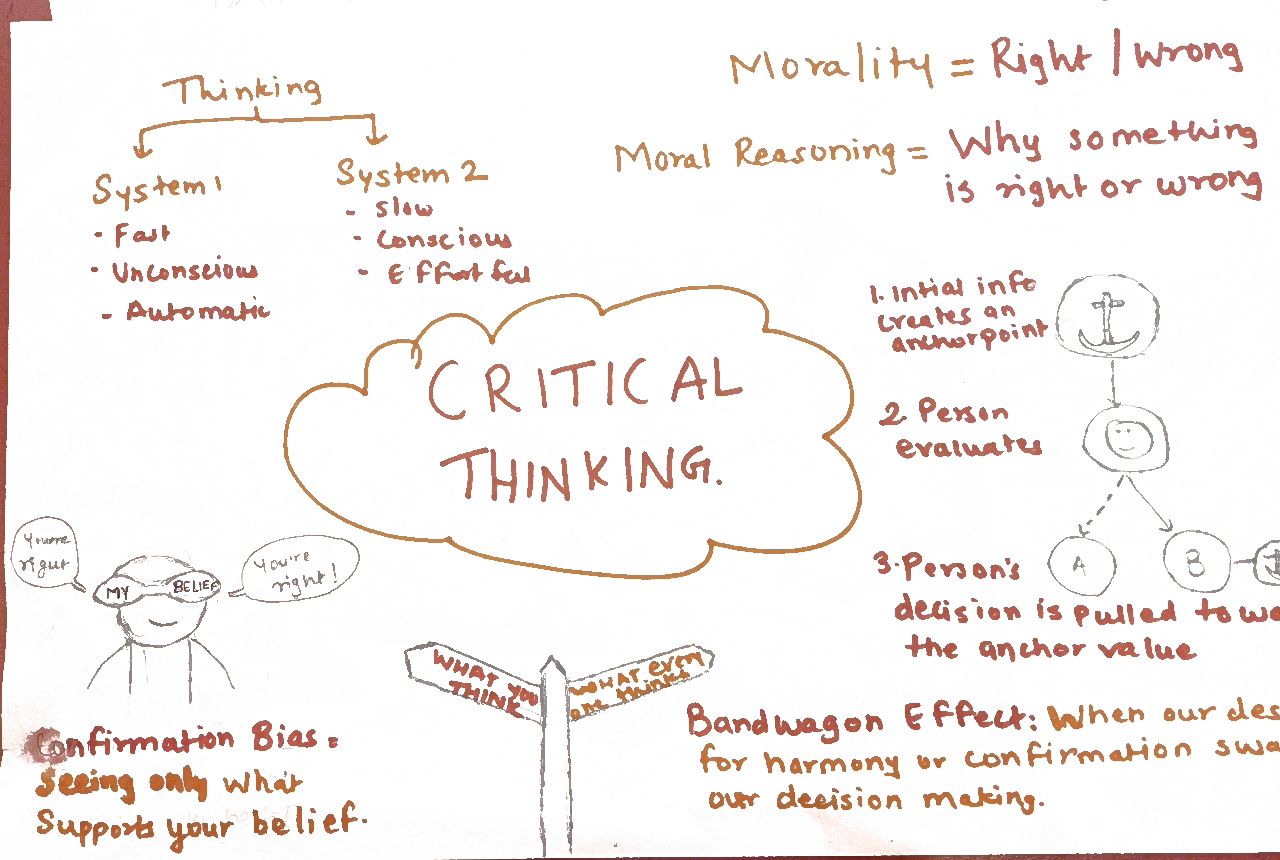
Critical Thinking
Critical thinking is more than just thinking carefully; it is about thinking clearly, logically, and ethically. Over the course of my learning, I have developed a deeper understanding of moral reasoning, ethical theories such as utilitarianism, rule utilitarianism, and self-interest theory, as well as how to approach ethical dilemmas with a structured and reflective mindset. This journey has not only improved my academic skills but has also influenced how I make decisions in everyday life.
One of the most important concepts I learned is moral reasoning. Moral reasoning is the process of determining what is right or wrong in a given situation. It requires us to go beyond personal opinions and emotions and instead rely on principles, evidence, and logical thinking. Before studying this topic, I often made judgments based on instinct or personal values without fully analyzing the situation. Now, I understand that moral reasoning involves asking questions such as: Who will be affected? What are the possible consequences? Are there any ethical principles involved? By systematically examining these questions, I can arrive at more balanced and justified conclusions.
A key theory that shaped my understanding of moral reasoning is utilitarianism. Associated with philosophers like Jeremy Bentham and John Stuart Mill, utilitarianism argues that the morally right action is the one that produces the greatest good for the greatest number of people. This outcome-based approach emphasizes consequences rather than intentions. I found this theory both practical and challenging. On one hand, it encourages us to think about the broader impact of our actions. On the other hand, it raises difficult questions: What if achieving the greatest good harms a minority? Is it always fair to prioritize the majority? Reflecting on utilitarianism helped me realize that ethical decisions are rarely simple and often involve trade-offs.
Building on this idea, I also learned about rule utilitarianism. Unlike act utilitarianism, which evaluates each action individually, rule utilitarianism suggests that we should follow rules that generally lead to the greatest good. For example, a rule such as “do not lie” tends to create trust and stability in society, even if lying in a specific situation might produce a better short-term outcome. This perspective helped me understand the importance of consistency and long-term consequences in ethical thinking. It showed me that moral systems need structure, not just case-by-case calculations.
Another important theory I explored is self-interest theory, which argues that individuals should act in ways that promote their own long-term interests. At first, this seemed selfish or morally questionable. However, through critical reflection, I realized that self-interest theory does not necessarily mean harming others. Instead, it can involve making rational decisions that protect one’s well-being and future. For instance, choosing to study instead of procrastinating may not provide immediate pleasure, but it serves my long-term goals. This theory made me reflect on the balance between personal benefit and social responsibility.
Ethical dilemmas were one of the most engaging parts of my learning. An ethical dilemma occurs when there are two or more conflicting moral principles, and choosing one means compromising another. These scenarios forced me to apply the theories I learned rather than just memorize them. For example, in a situation where telling the truth could cause harm, utilitarianism, rule utilitarianism, and self-interest theory might each suggest different actions. Working through such dilemmas taught me that critical thinking requires patience, open-mindedness, and the ability to tolerate uncertainty.
Learning how to think critically has been transformative. Critical thinking involves analyzing arguments, identifying assumptions, evaluating evidence, and considering alternative perspectives. I learned to question sources of information, distinguish between facts and opinions, and recognize biases — including my own.
Overall, studying moral reasoning and ethical theories has expanded my understanding of right and wrong. Utilitarianism and rule utilitarianism taught me to consider consequences and societal rules, while self-interest theory highlighted the importance of long-term personal well-being. Ethical dilemmas challenged me to apply these theories in complex situations. Most importantly, learning how to think critically has given me the tools to approach problems thoughtfully and responsibly. This experience has not only shaped my academic growth but has also prepared me to make more informed and ethical decisions in the future.
Attending the critical thinking classes has been an enriching and thought-provoking experience. One of the central themes discussed was the concept of knowledge and the process of knowledge acquisition. We explored what knowledge truly means and how it is not limited to facts and information, but also includes understanding, interpretation, and reasoning. It was interesting to realize that knowledge can be acquired through various sources such as personal experience, observation, education, discussion, and reflection. We also examined how our beliefs, biases, and prior experiences influence what we accept as knowledge. This made me reflect on the importance of questioning information rather than accepting it at face value.
A particularly engaging part of the session was the discussion on the case of Jammu and Kashmir (J & K). Instead of viewing it from a single narrative, we were encouraged to examine it from multiple perspectives, including political, historical, social, and humanitarian viewpoints. This exercise highlighted how the same situation can be interpreted differently depending on one’s background, values, and access to information. It reinforced the idea that critical thinking requires openness, empathy, and the willingness to consider diverse viewpoints.
The discussion helped me understand that knowledge is not always absolute or fixed; it can evolve with new evidence and perspectives. It also emphasized the importance of being an active learner—asking questions, analyzing information carefully, and being aware of biases. Overall, the class strengthened my ability to think more deeply and objectively about complex issues. It reminded me that true learning goes beyond memorizing facts; it involves understanding context, evaluating perspectives, and developing informed opinions. This experience has encouraged me to become a more reflective and responsible learner.